
Tag: Change process
-

The art of economics
Just as artists, writers, musicians, poets and film-makers have brought the climate emergency to wider attention by weaving it into their work, the time has come to embrace economic change as a cultural imperative.
-
What’s the opposite of neoliberalism?
For this to be the progressives’ moment, a new uniformity of purpose and message is needed.
-
Where next, after Brexit?
Britain is in a unique position from January 1st to become the pioneer of a new economic model, paving the way for a global economy to escape its unsustainable, inefficient ways.
-
How economic stress is feeding political division
The deepening divides in both US and UK politics are fuelled not by inequality but by the economic stress to which everyone is vulnerable. To reduce that stress we need to change the system that is creating it.
-
Money talks, but loneliness is silent
How lockdown could help shape a new economy based on the things that people really care about.
-
Business shouldn’t fear a reformist government, but investors might…
A story in Today’s Guardian, and particularly its headline, illustrates perfectly how the word “business” has become co-opted by the rich and powerful, so it no longer means what it ought to mean.
-
The election has started something, but for lasting change we need to go deeper
If we’re interested in long-term change, if we want a new economic and political system that values human wellbeing and respects the environment upon which it depends, then the outcome of the general election may well have been as much as we could hope for.
-
Trump’s victory, like the Brexit vote, doesn’t solve anything, but it puts the system in play and we must be ready for that
Memory soon adjusts to a new reality. A few months ago I woke up (in France, as it happens) to the news of Brexit; this morning’s news of the US election is of the same shocking quality. As with Brexit, we have no idea what this really means, but the sense of shock will pass,…
-
The Basic Income can fix Corbyn’s nuclear problems
Much of my childhood was spent in rural east Somerset, at the foot of the Mendips. For us children, Frome was “the smoke” – an industrial town that we only visited for its railway station, or for rare purchases that more local shops could not provide.
-
Planning a ‘New Economy’ politics for the post-Brexit age
I’ve been off the air for a while, partly because I’ve been away, and partly because there seemed, initially, almost nothing to contribute about British politics in the post-referendum maelstrom.
-
If we want a kinder, gentler politics, we must first shape a kinder, gentler, economic system
A member of parliament is murdered while doing her job. Flags fly at half mast, parliament is recalled for tributes, campaigning in the referendum is suspended, the prime minister and the leader of the opposition share a platform and the challenger parties decide not to contest the now vacant seat.
-
The basic income will make sense when people learn to value their unpaid work
Which is more remarkable – that 77% of Swiss voters rejected proposals for a basic income in a referendum last weekend, or that 23% voted in favour?
-
We are still paying the price for New Labour’s missed opportunity
Listening back to Tony Blair telling the BBC on Saturday that “it would be a very dangerous experiment for a major western country to get gripped by this type of populist policy-making, left or right” it’s hard to make sense of his subsequent claim that he wasn’t talking about Jeremy Corbyn.
-
A national policy framework for independent candidates?
Wednesday’s meeting in Totnes, organised by South Devon Watch to discuss strategies for political change, was inspiring and challenging in equal part.
-

Greek crisis: time to invert the hierarchy of wealth in Europe
In this alternative hierarchy, money facilitates the work that people do for themselves, rather than obstructing them by putting resources out of their reach.
-
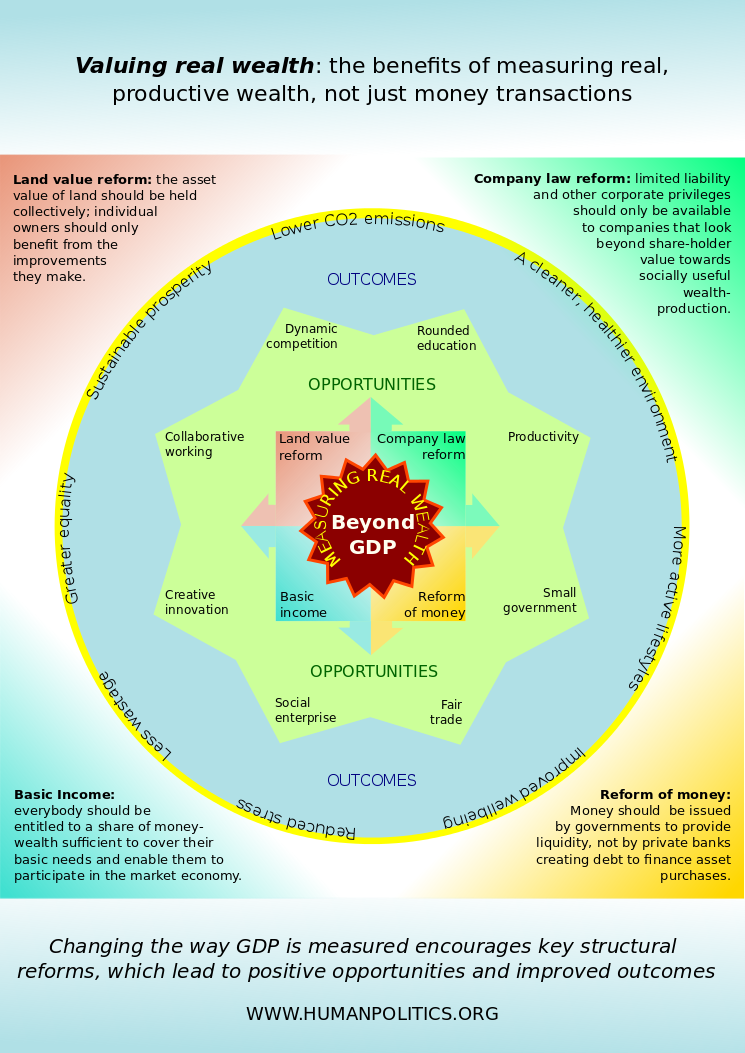
Beyond GDP – how measuring real wealth can pave the way for the basic income
Wellbeing increases through a virtuous, self-reinforcing cycle; unlike money, it is not a zero-sum game.
-
Growing wellbeing is hard when the system is against you
People from Totnes and the surrounding community gathered in the Methodist Church earlier this month to hear Professor Lorenzo Fioramonti, a global thought leader in the “Beyond GDP” movement
-
Russell Brand is on to something
The political and economic system is addicted and needs contact with a “greater power”.
-
Business as usual?
Does the much-heralded “recovery” mean a return to “business as usual” in British politics? Don’t count on it…
-
A wise old bird…
Nearly half a century ago, the headmaster of a mid-rank independent school awoke to find that he had something akin to a riot on his hands.
-
Rules, and their consequences
In principle, the campaign started by Nick Clegg to find out which laws, rules and regulations people want to abolish is music to the ears of those in tune with human politics, the guiding principle of which is that human relationships should be governed by mutual respect and understanding rather than artificial or arbitrary rules.
-
Words of wisdom
After what seems like weeks of over-heated speculation and grotesquely uninformed commentary about Jon Venables, at last some words of wisdom from somebody who, even if they don’t know the details of the specific case, appears at least to have a humane and principled grasp of the issues underlying it.
-
Welcome back
Family events caused an abrupt cessation in blog posts last Spring. By the time I came to pick it up again after a couple of months, my thinking had moved on to the point where I could see that the real need was for a coherent, comprehensive statement of Human Politics as a joined-up system of political…
-
A social contract?
On holiday I’ve been reading the recently published Predictably Irrational by Dan Ariely, whose website on the same subject can be found here.
-
Good and bad regulation
I missed this piece about the Manchester session of the Convention on modern Liberty and was glad to find it when trying to locate this item about the forthcoming UN declaration on drugs strategy. This declaration, we are told, is likely to commit the UN to another ten years of failure it its approach to recreational and addictive drugs.
-
My Billy Bragg moment
The Convention on Modern Liberty lived up to expectation and more – a very well organised and inspiring event with particular richness in the group sessions.
-
Knowing when to quit
In 1997 the British people wanted a new politics, but the failed gestures of the intervening seven years have brought them back to precisely the disillusioned state from which they sought to escape at that time.
-
Representative government
Society is complicated, and a legislature split between two dominant parties presents a bogus polarity in which those complications are unrepresented.
-
Race to the bottom
Saying “no” is not enough. When people start to question UKIP’s alternative they will find the answers to be pretty thin.
-
Calling “time” on prohibition
John Reid’s remarks about smoking are a timely reminder that behavioural change depends upon providing attractive alternatives. Mere enforcement is not enough.
-
United we stand…
Public attitudes are so poisoned that for British governments there can be no such thing as a successful policy on Europe.
-
With all due respect
Al Qaida and Fathers 4 Justice may be a very far cry indeed from one another, but they occupy, nonetheless, two places in a continuum of political failure.
-
Clever, modest and misunderstood
The development of the European Union has been a quiet, understated exercise in compromise which Britons might be expected to appreciate if they were permitted the political head space to reflect upon it.
-
Inconsequential opinions
David Blunkett and Tony Blair think that identity cards are a good thing. And opinion pollsters tells us that maybe 80 per cent of adult Britons think so too. But is this good enough reason for a policy for which the practical benefits seem remarkably thin?
-
The old realities of history
The endorsement by George Bush of Ariel Sharon’s self-serving plan to withdraw from the Gaza Strip while retaining substantial sections of the West Bank is pure politics and will have little if any influence on whatever settlement is eventually reached in that region.
-
Tell it like it is
The government’s immigration policy is collapsing because it is trying to do one thing while saying another.
-
Constitutional crumble
A bizarre confrontation between the Commons and the Lords over an obscure bill has wide implications for the way that legislation is reviewed. How much longer can Britain’s creaking constitution cope with a government so determined to get its way?
-
Metaphorical jig-saw puzzles
The government will get nowhere if it continues to make war against young people. Occupation, not punishment, is what they need.
-
Finding reverse gear
At the onset of hubris, can schadenfreude be far behind? But it’s not too late for Tony Blair to acknowledge that his Labour critics have a point of view, too.
-
A classic problem-solving error
Civil society is complicated and messy. Giving everyone a piece of plastic with a number on it will not make it less so.
-
Plus ça change…
Tony Blair’s big speech lacked purposeful ideas about where to take his government. For Labour, he seemed to say, the best it can hope to do is keep the Tories at bay.
-
Inevitability postponed
The emergence of a new identity among the less developed countries at Cancun sends a signal that the introspective mega-economies of the West will ignore at their peril.
-
The “when?” of destiny
Some things are bound to happen, one day, but it needn’t be tomorrow. If future generations are to thank them, political leaders need to know when to embrace destiny and when to fight it with a policy of “inevitability postponed”.
-
Meaning, not words
Language is democratic because only the listener or reader decides what it means. When a writer or speaker attempts to impose their message, they only succeed in deluding themselves.
-
The limits of power
Power lies in the ability to get things right. A decision is not right because the decision-maker is powerful, but because the process of reaching it has been effective. That requires openness to the truth, not managed information.
-
Getting things right
Information is only as good as the assessment that is made of it, but an assessment does not itself make the information true. No amount of power can make it true, either.
-
The devalued vote
The connection between elections and reality was always tenuous, but never more so than it is today. Non-voters are not nihilists, but honest citizens increasingly unwilling to collude in a deception.
-
Direction of travel
Transport secretary Alastair Darling is thinking the unthinkable on roads. Apparently, that means paying for them. But road-pricing alone won’t end congestion – it will just make people even more fed up when they find themselves paying to be stuck in a jam.
-
Keeping things complicated
Good decision-making is a process of questioning, and that involves listening carefully to the answers that you least expect.
-
Addressing the issue
Suicide bombers have big commitment to their cause. That’s why they do it. Their terrorists acts do not invalidate the cause, they merely push it up the agenda. That’s why, when the cause is popular, terrorism often works.
-
Policy baggage
The results of the local elections in England raise questions for all three main parties. But really it all comes down to one big question: What is a political party for?
-
Jaw, jaw in Europe
When Germany, France, Belgium and Luxembourg sat down last week to talk about European defence co-operation, their efforts received a mixed reception. Some people were irritated, some derisive, some embarrassed, some sceptical and some, doubtless, quietly pleased.