
Category: Personal blog
-

The art of economics
Just as artists, writers, musicians, poets and film-makers have brought the climate emergency to wider attention by weaving it into their work, the time has come to embrace economic change as a cultural imperative.
-
What’s the opposite of neoliberalism?
For this to be the progressives’ moment, a new uniformity of purpose and message is needed.
-
Today’s budget will raise house prices. That’s bad news for everybody, including homeowners
The headlines for home owners in today’s budget are an extension to the stamp duty “holiday” and guarantees for 95% mortgages. Neither step will contribute to what should be the overriding policy objective, which is to make homes more affordable. Instead they will just push prices up still further.
-
Getting creative
The end of free movement in Europe, coming on top of the Covid shutdown, has left the UK’s creative community reeling. But radical reform in both finance and education policy can get it back on its feet.
-
Where next, after Brexit?
Britain is in a unique position from January 1st to become the pioneer of a new economic model, paving the way for a global economy to escape its unsustainable, inefficient ways.
-
We need to talk about financial services…
Buying British is an uphill struggle. Is the City’s vaunted financial services industry to blame?
-
Cutting the aid budget won’t help anyone in Great Britain
The government’s decision to cut the overseas aid budget by about £4 billion has been portrayed as “red meat” to its electoral base, which is presumed to want to put “Britain first”.
-
Moving the chairs on the Titanic
As Chancellor Rishi Sunak moved the chairs around on the slowly sinking deck of the UK economy on Wednesday, one thing we can say for certain is that the well-off, and particularly the super-well-off, will come out of the economic downturn very much better off than everybody else.
-
How economic stress is feeding political division
The deepening divides in both US and UK politics are fuelled not by inequality but by the economic stress to which everyone is vulnerable. To reduce that stress we need to change the system that is creating it.
-
Money talks, but loneliness is silent
How lockdown could help shape a new economy based on the things that people really care about.
-
Business shouldn’t fear a reformist government, but investors might…
A story in Today’s Guardian, and particularly its headline, illustrates perfectly how the word “business” has become co-opted by the rich and powerful, so it no longer means what it ought to mean.
-
The government is in a hole over housing. Time to stop digging
As the fallout from the terrible fire at a tower block in North Kensington continues, it may still be months before we know the precise details of what went wrong. The broader context, however, is already clear.
-
The election has started something, but for lasting change we need to go deeper
If we’re interested in long-term change, if we want a new economic and political system that values human wellbeing and respects the environment upon which it depends, then the outcome of the general election may well have been as much as we could hope for.
-
Trump’s victory, like the Brexit vote, doesn’t solve anything, but it puts the system in play and we must be ready for that
Memory soon adjusts to a new reality. A few months ago I woke up (in France, as it happens) to the news of Brexit; this morning’s news of the US election is of the same shocking quality. As with Brexit, we have no idea what this really means, but the sense of shock will pass,…
-
Plucky Wallonia exposes the lie at the heart of EU trade policy
Policy strives to achieve the things that it measures, and nothing is more fervently measured in modern economies than GDP.
-
The Basic Income can fix Corbyn’s nuclear problems
Much of my childhood was spent in rural east Somerset, at the foot of the Mendips. For us children, Frome was “the smoke” – an industrial town that we only visited for its railway station, or for rare purchases that more local shops could not provide.
-
How Britain’s Olympics success makes the case for the Basic Income
One week later, the spectacle of Team GB’s Olympics medals triumph seems a distant memory. It was great while it lasted, not least because it was so unexpected, but the British passion for sports has more to do with commitment that results.
-
Planning a ‘New Economy’ politics for the post-Brexit age
I’ve been off the air for a while, partly because I’ve been away, and partly because there seemed, initially, almost nothing to contribute about British politics in the post-referendum maelstrom.
-
If we want a kinder, gentler politics, we must first shape a kinder, gentler, economic system
A member of parliament is murdered while doing her job. Flags fly at half mast, parliament is recalled for tributes, campaigning in the referendum is suspended, the prime minister and the leader of the opposition share a platform and the challenger parties decide not to contest the now vacant seat.
-
The basic income will make sense when people learn to value their unpaid work
Which is more remarkable – that 77% of Swiss voters rejected proposals for a basic income in a referendum last weekend, or that 23% voted in favour?
-
When the referendum’s finally over, the important questions will still be with us
With the referendum sitting on a knife-edge, it is increasingly pointless to speculate on an outcome that will be known in a little over a fortnight. In any case, that result will solve nothing.
-
We are still paying the price for New Labour’s missed opportunity
Listening back to Tony Blair telling the BBC on Saturday that “it would be a very dangerous experiment for a major western country to get gripped by this type of populist policy-making, left or right” it’s hard to make sense of his subsequent claim that he wasn’t talking about Jeremy Corbyn.
-
A national policy framework for independent candidates?
Wednesday’s meeting in Totnes, organised by South Devon Watch to discuss strategies for political change, was inspiring and challenging in equal part.
-
EU referendum: a false dichotomy obscuring a far more vital struggle
Continuing the Referendum theme, a friend wishes they knew what the E.U. really does for us. This is not a Life of Brian moment but a measured desire to understand the pros and cons in order to make an informed decision.
-
Brexit debate: a plague on both their houses
David Cameron wants people to be in no doubt about the disastrous consequences of leaving the E.U.
-
In a single sentence, the DfE tells us everything that is wrong with both the education system and our socio-economic structures
“The evidence is clear that every extra day of school missed can affect a pupil’s chance of gaining good GCSEs, which has a lasting effect on their life chances.” So said the Department for Education, responding to a High Court judgement that children who regularly attend school may be permitted family absences.
-
Let’s not weep for the departing oligarchs – resilience begins at home
Yesterday, billionaire hedge fund managers; today, the nameless super-rich buying into London’s property market.
-
Extreme wealth is not a “victimless crime”
Twenty-five hedge fund managers took home $13 billion in earnings last year, according to a new report. Easy enough to be appalled, outraged, disgusted – or even impressed – but what does this really mean for the rest of us?
-
Housing crisis: there’s only one boat, and we’re all in it
Having spent the weekend debating the divisiveness of party politics, let’s cut to the chase and talk about one of the big political issues of the day, which is housing.
-
People don’t vote, because the system offers no solutions
In our tribal, divisive electoral system it’s no surprise that the biggest group of all is completely absent. In London on Thursday, 54% did not vote; in Scotland the figure was 44% and in Wales 56%.
-
Time to challenge the divisive values of party politics
Allegations that the Tories stole the last election by cheating on their spending are far more than a storm in an over-heated social media teacup. They point to an overweaning sense of entitlement in a system that disproportionately favours the big parties.
-
Education is a relationship between pupils, parents and teachers. The government should keep out.
Education is a partnership between parents and teachers, designed to help children to flourish in their own, unique ways. It’s a vital engagement upon which government is systematically trampling, kicking both parties with equal vehemence with its oversized boots.
-
Rescuing child refugees is valuable work, but the system can’t see it
Which is more valuable? The rescuing of vulnerable refugee children, or the management of a retail chain in the years prior to its collapse? By “more valuable” I mean which of these two activities brings more benefit to society?
-
Junior doctors are the standard bearers for a new economy
This government’s confrontation with junior doctors, which looked at one point like a traditional labour dispute about terms and conditions, has morphed into something much more important.
-
Productivity in crisis – armies of middlemen living on the backs of the productive few
To an otherwise comprehensive overview of the UK’s productivity crisis by Duncan Weldon in The Guardian on Monday, one key factor could be added. Paid work is not necessarily productive, and not all productive work is paid.
-
Decades of sell-offs leave Britain unable to pay its way in the world
Nearly forty years of selling off publicly-owned utilities, nationalised industries, national infrastructure and even basic government services means that Britain’s capacity to retain its own wealth is severely depleted.
-
To provide affordable housing, we need to defy the conventions of the market
If local authorities want affordable housing, they need to drive prices down, not feed the flames of a raging market. That means providing housing land at less than its market value
-
Sanders the outsider is far ahead of Clinton in the national race
ing the New York Primaries last night The Guardian reports that the increasing prospect of Trump and Clinton facing each other in the general election in November will trouble many Republicans.
-
Brexit or Bremain – not much of a choice…
George Osborne’s blood-chilling predictions of financial armageddon (a cost of £4,300 a year per household) in the event of Brexit make me want to run screaming into the “No” camp – there to make common cause with a bunch of people with whom I disagree on almost everything.
-
GDP is the enemy of rewilding Britain
The whole point of recreating a wilderness is that you do not exploit it for extractive gain. You value it for its natural diversity, which GDP will never do.
-
The House of Commons is debating TTIP on Thursday
Here is the text of a letter I’ve sent to my local MP.
-
Disgust at ISIL’s cruelty is not a good basis for bombing Syria
As shadow foreign secretary, Hilary Benn is at the sharp end of the debate fissuring the Labour Party about whether or not to join the bombing campaign in Syria.
-
How Gross National Happiness can reinvigorate the left in Europe
In the wellbeing narrative, value lies in whatever improves the experience of people’s lives. Money is a useful tool, but not an end in itself
-
Why does anyone imagine that the Greek government will sign?
As the marathon Sunday evening Eurozone summit stretches out into the early hours of Monday morning, it is a rash moment to write a post that may be proved wrong by breakfast.
-
Just because most caring work is unpaid, it doesn’t mean that it’s not valuable
If we want to live healthier, happier, less lonely lives, then it makes sense to measure the economic value of the things that contribute to that – not just the transactions in which money changes hands.
-

Greek crisis: time to invert the hierarchy of wealth in Europe
In this alternative hierarchy, money facilitates the work that people do for themselves, rather than obstructing them by putting resources out of their reach.
-
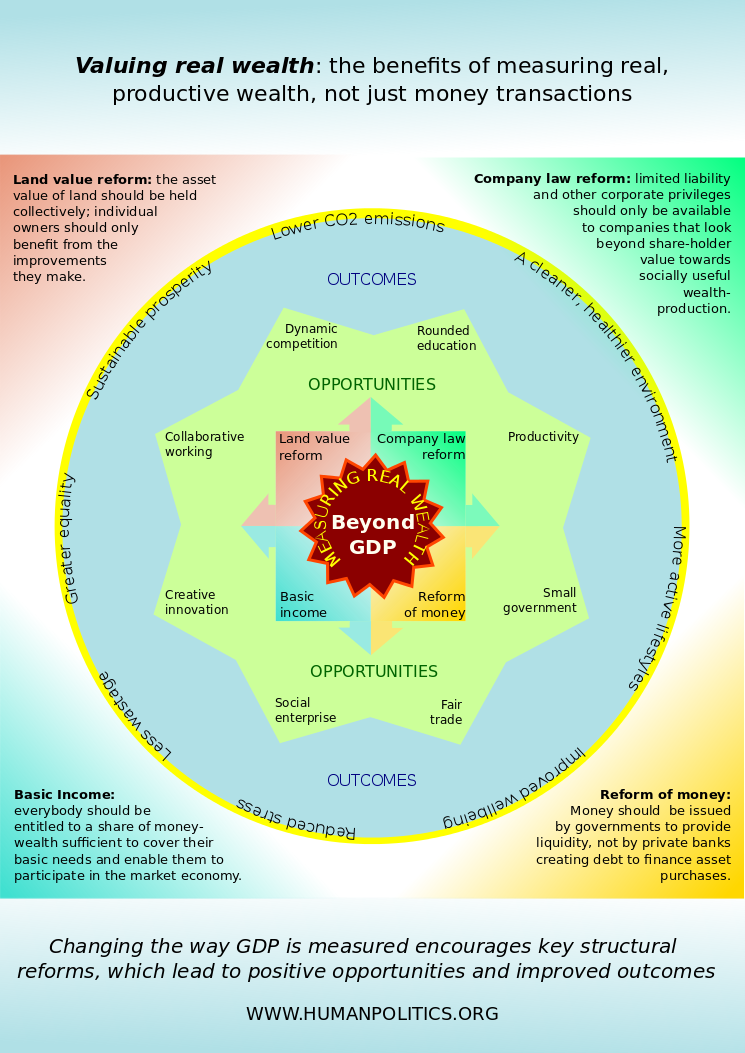
Beyond GDP – how measuring real wealth can pave the way for the basic income
Wellbeing increases through a virtuous, self-reinforcing cycle; unlike money, it is not a zero-sum game.
-
Election 2015 – looking for the silver linings
If you’re one of the 63% who voted other than Conservative, you may not yet have turned to wondering whether any good news can be sifted from this morning’s surprise election result.
-
Voting for radical change in a stalemate election
Writing about politics from the perspective of radical change is a dead loss during an election. Everybody heads for the centre ground for fear of frightening the horses
-
Anger in Euroland, where “good news” is just for the markets
When the provision of basics such as housing, food, education and healthcare is vulnerable to the workings of financial markets (of which ordinary people have neither understanding nor control) it makes sense to reduce that vulnerability.
-
Ed Miliband is right about productivity. He just doesn’t know it
The benefit of a care visit may increase pro rata with its duration. A hurried “get in and out as quickly as possible” visit to give someone a bath is likely to create stress and anxiety for all concerned, but a leisurely “take your time” visit can do lasting good.
-
Growing wellbeing is hard when the system is against you
People from Totnes and the surrounding community gathered in the Methodist Church earlier this month to hear Professor Lorenzo Fioramonti, a global thought leader in the “Beyond GDP” movement
-
Never mind Putin – fracking and TTIP will make idiot of us all
If a society considers it worthwhile to go to the extraordinary trouble and expense of capturing carbon and storing it deep underground, the logical starting point is to release as little as possible of the carbon that is already captured and stored deep underground.
-
Will Greece bring back the middlemen?
Greek Finance Minister Yanis Varoufakis has a plan to link his country’s debt repayments to GDP growth. On the face of it, that makes sense.
-
Whose side is the European Union on?
The E.U. is in danger of ignoring a sea-change in politics that is convulsing in various degrees the majority of its member states.
-
The E.U. needs to learn the true meaning of “wealth”
A clean environment provides direct social benefits for everybody. The additional costs incurred by business will be repaid in spades by improvements in quality of life and human wellbeing.
-
How to earn £90,000 a year making sandwiches while saving the NHS
Plans by multinational food processing company Greencore to recruit overseas for the workers to staff a new sandwich making factory in Northampton provoked more questions than answers last week, not least the Daily Mail headline “Is there no one left in Britain who can make a sandwich?”
-
The Living Wage: not quite all that it seems?
The Living Wage Foundation has made remarkable progress over 15 years, and in Living Wage Week, when new rates for 2014-15 are announced, it might seem churlish to carp at the detail.
-
The £117 per hour childcare subsidy
George Osborne was out and about, last week, talking up the government’s plans to get more women into work, mostly by providing childcare incentives.
-
Russell Brand is on to something
The political and economic system is addicted and needs contact with a “greater power”.
-
Car wars: the environmental cost of TTIP
E.U. officials are keen to let us know that most of the benefits of the Transatlantic Trade and Investment Partnership – the vast and controversial trade deal currently in negotiation – will come from reducing “non-tariff trade barriers”, known as NTBs.
-
Human rights can be hard to grasp, but the clue is in the name
If everybody had agreed with him, the great Conservative William Wilberforce would not have had to dedicate so much of his life to the abolition of slavery in British realms.
-
TTIP – four letters that spell rising poverty
Bilateral trade agreements have been around for a long time, but thanks to TTIP – the big daddy of them all – and its controversial ISDS provisions, both the general public and the world of politics are finally sitting up and taking notice.
-
Keeping it local
The unseemly blame game over the flooding of the Somerset levels is a good reason to return the power of problem-solving into local hands.
-
Why “investment in jobs” is a route to low wages
Mr Miliband wants to raise the minimum wage to £8 by 2020. This could be worth £3,000 a year, he tells the Labour Party Conference, deftly multiplying the £1.50 increase by 40 hours and 52 weeks.
-
Compassionate politics – was this a eureka moment?
If a family has been settled in Britain for a number of years, if the children have grown up here and go the school here and have no real concept of a home elsewhere, the question of how they got here, is objectively, completely irrelevant.
-
Ofsted and the “false dichotomy”
From this September, 40% of two year olds will be eligible for free childcare – a total of 260,000 children, according to government calculations.
-
The Luddites are having their day
Economists are puzzled by jobs and wages data that continue to show rising employment accompanied by falling real wages.
-
Joined up government?
When is work productive and useful, and when is it just a drag on the productive and useful things that people want to do?
-
The wrong conversation
The campaign to prevent UK asylum seeker Afusat Saliu being returned to Nigeria, where she fears her two daughters will be victims of female genital mutilation, looks unlikely to succeed, despite 100,000 people signing up in 4 days to the petition on change.org.
-
Are they reading the small print?
Did Nigel Evans vote for the Legal Aid, Sentencing and Punishment of Offenders Act 2012? Presumably not, because as a deputy speaker of the House of Commons he had forsworn political partisanship in that chamber. Would he have voted for it had that not been the case?
-
Behind the headlines
The latest inflation figures show a headline number below 2%, but it all depends what you buy…
-
The value of a missile
UK defence secretary Philip Hammond is reported to be encouraging his junior ministers to lobby the shipbuilding unions, in order to put some backbone into a Labour party said to be going soft on the replacement of the Trident nuclear deterrent.